

Quick answer
A non-conforming home loan is a mortgage for borrowers who fall outside a bank's standard credit rules, for example because of defaults, a discharged bankruptcy, a Part 9 debt agreement, past arrears or income that is hard to prove. Specialist and non-bank lenders assess these files case by case. Ownright Custom Finance arranges them Australia-wide and plans the path back to a mainstream loan.
Key points
- "Conforming" means fitting the standard rules banks and mortgage insurers use; everything outside them is non-conforming
- Lenders sort files into tiers, from near-prime to specialist to private, and the tier drives cost and conditions
- How old a credit problem is, whether it was paid and why it happened matter more than the label
- Expect risk-based pricing and fees, so compare the total cost, including exit costs
- The best non-conforming loan is one you can refinance out of once your file recovers
- Suits
- Defaults, judgments, past bankruptcy or Part 9, arrears, irregular or hard-to-prove income
- Lenders
- Near-prime, specialist and non-bank lenders; private lenders for business or investment purposes
- Uses
- Buying a home, refinancing, consolidating debts, catching up arrears
- Australia-wide
- Yes, every state and territory
What is a non-conforming home loan?
A non-conforming home loan is a mortgage written outside the standard rules that banks, and the lenders mortgage insurers that stand behind many bank loans, use to approve borrowers. If your file “conforms”, it slots into those rules: clean credit, standard payslips or tax returns, an ordinary property. If one piece does not fit, the bank’s system usually says no, even when the rest of your situation is strong.
Non-conforming lenders fill that gap. They are mostly non-bank and specialist lenders that write their own credit policies and fund loans through their own warehouses and securitisation programs. The Reserve Bank described the sector as early as 2005, noting that these lenders serve borrowers who do not meet the standard criteria of mainstream lenders. You will also see the same loans called specialist, near-prime or non-prime home loans.
Non-conforming loans or non-conforming home loans: which do you need?
“Non-conforming loans” is the broad term. It covers any credit written outside mainstream rules, including car loans, personal loans, business loans and commercial property finance. “Non-conforming home loans” is the slice secured by residential property, usually your home or an investment property.
This page is about home loans, because that is where non-conforming lending matters most and where the stakes are biggest. If you need a business or commercial loan instead, see business loans with bad credit or commercial loans with bad credit.
Who needs a non-conforming home loan?
The common thread is one feature that a bank’s scorecard will not accept. Typical examples:
- Credit events. Defaults, court judgments, missed repayments or a string of recent credit enquiries.
- Bankruptcy or a Part 9 debt agreement, current or discharged.
- Mortgage arrears on your current loan, or a lender who has issued a default notice.
- Tax debt with the ATO. See home loans with ATO debt.
- Income that is real but hard to prove, such as a new ABN, irregular contract work or late tax returns. See no doc and alt-doc home loans.
- Residency or visa issues, or income earned overseas.
- An unusual property, such as a small unit, a mixed-use building or a rural block.
Plenty of people need a non-conforming loan for only one of these reasons. A clean credit file does not guarantee a bank approval, and a messy one does not rule out a sensible loan.
How do specialist lenders grade a non-conforming file?
This is the part most borrowers never see. Behind the scenes, lenders and brokers sort files into tiers before anyone talks about pricing. Ownright’s director, Trevor Scott, spent years on the lender side of this market, including as national sales manager at a specialist home lender, so we build every application around the tier it will be assessed in.
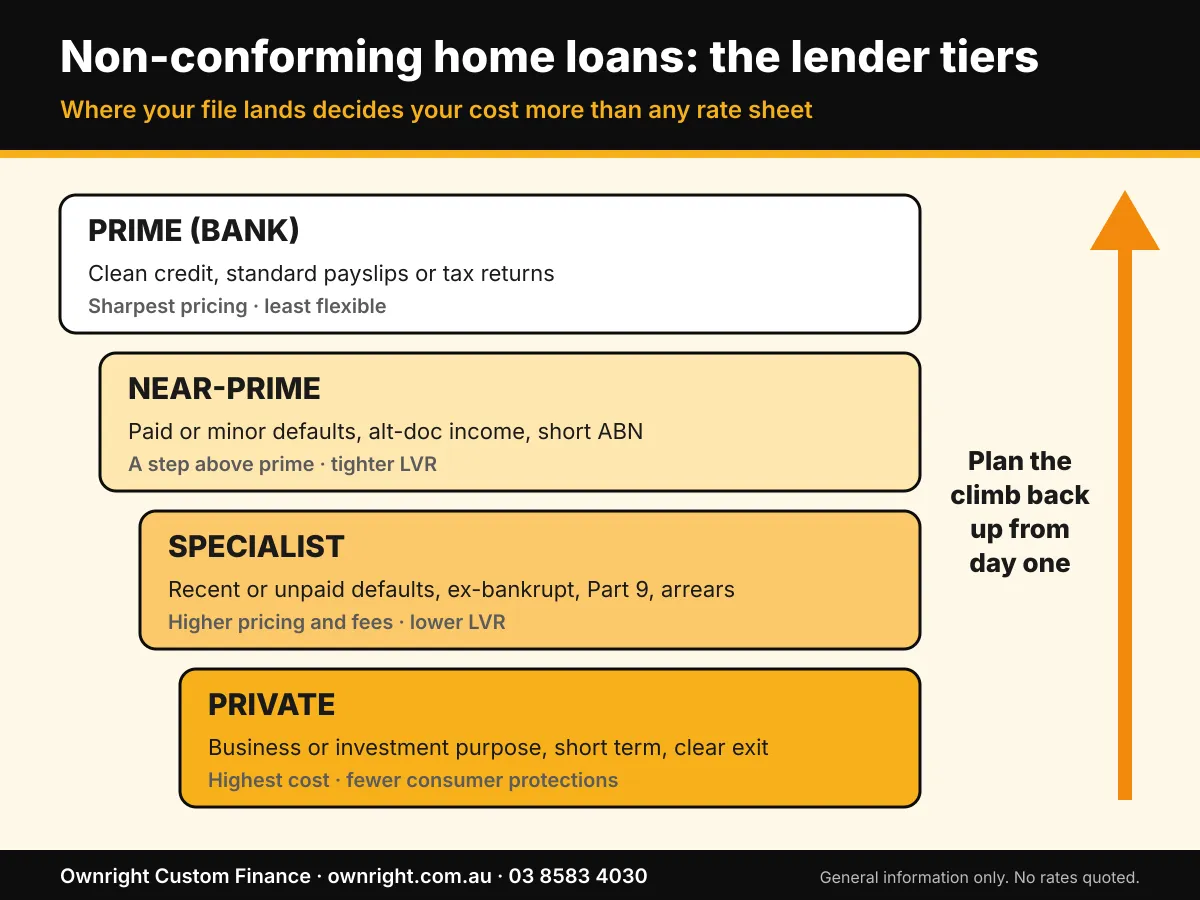
| Tier | Typical file | What the lender accepts | The trade-off |
|---|---|---|---|
| Prime (bank) | Clean credit, standard income evidence | Very little outside the rules | Sharpest pricing, least flexibility |
| Near-prime | Minor or paid defaults, alternative income evidence | Small, explained blemishes and alt-doc income | Pricing a step above prime, tighter loan-to-value limits |
| Specialist | Recent or unpaid defaults, discharged bankruptcy, Part 9, arrears | Serious credit events with a clear story and equity | Higher pricing and fees, lower loan-to-value limits |
| Private | Situations no regulated lender will take, usually business or investment purpose | The property and a clear exit, more than the credit file | Short terms, highest cost, fewer consumer protections |
The aim is always to place you in the highest tier your file genuinely qualifies for. A borrower who could have been near-prime but lands in a specialist loan pays for that mistake every month. We go deeper into the tiers in our guide to non-conforming lenders.
What do non-conforming lenders weigh most?
A specialist credit assessor reads your file as a story. Five questions decide most outcomes:
- How old is the problem? A default from four years ago carries far less weight than one from four months ago.
- Was it paid, and how big was it? A small paid default is very different from a large unpaid judgment.
- Why did it happen, and what has changed? Illness, a business failure or a relationship breakdown, followed by stable conduct, is a story lenders understand.
- How much equity or deposit is there? More security lowers the lender’s risk and widens your options.
- Can the income be shown? Payslips, tax returns, BAS, bank statements or an accountant’s letter all count somewhere.
The written explanation matters. We prepare a short, factual letter that sets out what happened, the evidence, and why the risk has passed. A file that answers the assessor’s questions before they are asked moves faster.
How long do credit problems stay on your file?
Australian credit reporting has fixed retention periods. Knowing where you sit on these clocks tells you how your options will change.
| Item on your credit report | How long it generally stays |
|---|---|
| Repayment history information | 2 years |
| Credit enquiries | 5 years |
| Defaults, including paid defaults | 5 years |
| Court judgments | 5 years |
| Bankruptcy | 5 years from the start, or 2 years after it ends, whichever is later |
| Part 9 debt agreement | 5 years from the agreement, or 2 years after it ends, whichever is later |
You can request your credit report free from each credit reporting body. Moneysmart explains how. Check it before you apply anywhere, because an error you did not know about can sink an application.
What does a non-conforming home loan cost?
Non-conforming loans are priced for risk, so they cost more than a bank’s best offer. We never publish rates, because every loan is priced on the borrower, the property and the tier. What we can tell you is where the costs sit, so you can compare properly:
- The interest rate, which steps up with each tier.
- A risk fee or lenders mortgage insurance. Many specialist lenders charge a one-off risk fee instead of mortgage insurance.
- Establishment, valuation and legal fees.
- Ongoing fees, if any, on the loan account.
- Exit and discharge costs, which matter because you plan to refinance later.
Compare loans on total cost over the period you expect to hold them, not on the headline rate. A loan with a lower rate but heavy exit costs can be the dearer option if you refinance in two years.
Why the exit plan matters as much as the approval
A non-conforming home loan works best as a bridge. Credit events age, repayment history builds, and equity often grows. Each of those can move you up a tier.
From the first conversation we plan the exit: what your file needs to look like for a near-prime or prime lender, roughly when that might be realistic, and what to avoid in the meantime, such as new credit applications or missed bills. Nothing about a future refinance is guaranteed, because it depends on your conduct and on lender policy at the time, but borrowers who plan for it get there more often.
Non-conforming home loan or private mortgage?
Specialist lenders that write regulated home loans are the first port of call for most owner-occupiers. A private mortgage is a different tool. Private lenders lend mainly against the property, usually for business or investment purposes, for short terms, with a clear exit such as a sale or refinance. They can settle quickly when a regulated lender cannot, but the cost is higher and the consumer protections are not the same.
If your situation is urgent, for example a default notice on your current mortgage, read stop a mortgagee sale and urgent mortgage refinance. For a fuller picture of private lending, see private mortgages.
Protections you keep with a specialist lender
A non-conforming home loan for your own home is still regulated consumer credit. Under the National Consumer Credit Protection Act, overseen by ASIC, the lender and the broker must make reasonable inquiries about your needs and finances and must not put you into a loan that is unsuitable. You can ask for hardship help if your circumstances change, and you can take a complaint to the Australian Financial Complaints Authority. Those rights apply whether the lender is a bank or not.
Red flags to walk away from
- Anyone who asks for fees before a lender has approved anything.
- A promise of approval before your file has been reviewed.
- Pressure to sign a declaration that the loan is for business purposes when it is really for your home.
- Advice to leave out debts or overstate income. Lenders check, and the consequences can be serious.
- A loan with no realistic way to refinance or repay at the end of the term.
An illustrative example
This scenario is illustrative only and does not describe a real client.
A couple in regional Queensland fell behind on bills when one partner’s small business closed. They have two paid defaults from three years ago, a clean record since, a stable wage and solid equity in their home. Their bank declined a refinance to consolidate a car loan and credit cards.
Ownright reads their credit file, gathers the evidence of the business closure and their conduct since, and writes the explanation. Their file fits a near-prime policy rather than a specialist one. The lender makes the final decision, but the application answers every question a credit assessor will ask, and the plan includes a review once the defaults pass the five-year mark.
How Ownright places non-conforming home loans
We start with your credit file, not a product. Most borrowers who come to us have been declined at least once, and often the decline came from submitting the wrong file to the wrong lender. Trevor Scott’s four decades in finance, on both the broker and lender side, means we know how specialist credit teams think and which policies fit which stories.
Then we do the work: the explanation letter, the evidence in the order an assessor wants it, the right tier and the right lender. We explain the total cost and the exit plan before you commit.
Documents to have ready
- Photo ID.
- Your latest payslips, or tax returns, BAS and bank statements if self-employed.
- Statements for your current home loan, cards and personal loans.
- Any letters about defaults, judgments, bankruptcy discharge or debt agreements.
- Details of the property you own or want to buy.
Talk to a broker who places these loans every week
Start your enquiry or call Ownright Custom Finance on 03 8583 4030. We are based in Knoxfield, Victoria, and arrange non-conforming home loans in every state and territory. This page was reviewed by our director, Trevor Scott. Read about Trevor and the team.
Ready when you are
Tell us about your loan
A short enquiry, no documents needed. Asking won't touch your credit file, and a real person who places hard loans every day reads it.
- Your plans
- A few details
- Contact
- Review
Enquiry only. No documents needed.
How it works, step by step
- 1
Step 1
You tell us what happened and what you need. We read your credit file with you before any lender sees it.
- 2
Step 2
We work out which tier your file belongs in: near-prime, specialist or private.
- 3
Step 3
We write the story behind the credit events and package the evidence so a credit assessor can say yes.
- 4
Step 4
We lodge with the lender whose policy fits, manage it to settlement and diarise a review for your exit to a better loan.
Frequently asked questions
What does non-conforming mean in a home loan?
It means the loan does not conform to the standard credit rules that banks and their lenders mortgage insurers apply. A borrower might fall outside those rules because of credit history, the way income is earned or documented, the property, or residency. Specialist lenders write their own policies for these situations.
Is a non-conforming loan the same as a bad credit home loan?
Bad credit is the most common reason for a non-conforming loan, but not the only one. Self-employed borrowers with alternative income evidence, people with a recent change of job or residency, and some unusual properties can also need a non-conforming lender even with a clean credit file.
Can I get a non-conforming home loan with a current default?
Some specialist lenders consider unpaid or recent defaults, usually with a lower maximum loan-to-value ratio and higher pricing. A paid default, a small default or one with a clear explanation is easier to place. We check how your lender options treat it before anything is lodged.
How long does a default stay on my credit report?
In Australia a default generally stays on your consumer credit report for five years, even after it is paid. Repayment history information stays for two years. Paying the default changes its status, which many lenders take into account.
Can I get a home loan after bankruptcy?
Yes, a discharged bankrupt can apply, and some specialist lenders will consider an application soon after discharge. Lenders look at how long ago the bankruptcy ended, your conduct since and your deposit or equity. Our post-bankruptcy page covers this in more detail.
Are non-conforming home loans regulated?
A home loan for personal, domestic or household purposes is regulated by the National Consumer Credit Protection Act, whether it comes from a bank or a specialist lender. That brings responsible lending checks, hardship rights and access to the Australian Financial Complaints Authority.
How soon can I refinance out of a non-conforming loan?
There is no fixed date. It depends on how quickly your credit file ages, your repayment conduct and your equity. Many borrowers review their position after a period of clean repayments. Check the exit or discharge costs in your loan contract before you sign.
Will enquiring with Ownright affect my credit score?
No. Making an enquiry with us does not place a credit enquiry on your file. A lender only lists an enquiry when a formal application is lodged, and we do not lodge anything without your agreement.