

Quick answer
Non-conforming lenders are mostly non-bank and specialist lenders that approve home loans outside mainstream bank rules. They usually sort borrowers into tiers: near-prime for minor or explained issues, specialist for serious credit events such as recent defaults or a discharged bankruptcy, and private lending for business or investment loans no regulated lender will take. Landing in the right tier is the biggest single factor in what you pay.
Key points
- Non-conforming lenders write their own credit policies, so the same file can get very different answers.
- Near-prime suits small or explained blemishes and alternative income evidence.
- Specialist lenders take serious credit events, usually with lower loan-to-value limits and higher pricing.
- Private lenders rely mainly on the property and an exit plan, mostly for business or investment purposes.
- Shopping your file to several lenders adds credit enquiries that can push you down a tier.
What are non-conforming lenders?
Non-conforming lenders approve home loans that fall outside the standard rules banks use. In Australia most are non-bank lenders. They raise money through warehouse facilities and by selling bundles of loans to investors (securitisation), rather than from customer deposits. Because each one sets its own credit policy, two non-conforming lenders can look at the same file and give completely different answers.
That variety is the opportunity. It is also why the first application matters so much. This guide explains how the market is layered, so you can see where your file is likely to land. For the loan itself, see our main page on non-conforming home loans.
How do non-conforming lenders sort borrowers into tiers?
Most specialist lenders run more than one product tier, each with its own pricing and limits. Brokers who work in this market think in the same tiers.
Near-prime
Near-prime is for borrowers who almost fit a bank. Typical files include a paid default, a short self-employment history with good evidence, alt-doc income, a recent change of job, or a debt consolidation that a bank’s serviceability calculator rejected. Pricing sits a step above prime, and many near-prime borrowers can refinance to a bank once the issue ages.
Specialist
Specialist products take the files with serious credit events: recent or unpaid defaults, court judgments, a discharged bankruptcy, a Part 9 debt agreement, or mortgage arrears. Expect lower maximum loan-to-value ratios, higher pricing and fees, and closer questions about what happened. A clear written explanation and solid equity carry real weight here.
Private
Private lenders sit outside the regulated home loan market for most purposes. They lend mainly against the property and the exit plan, usually for business or investment purposes and for short terms. They can move quickly and take situations no regulated lender will, but cost is highest and consumer protections differ. See private mortgages before considering one.
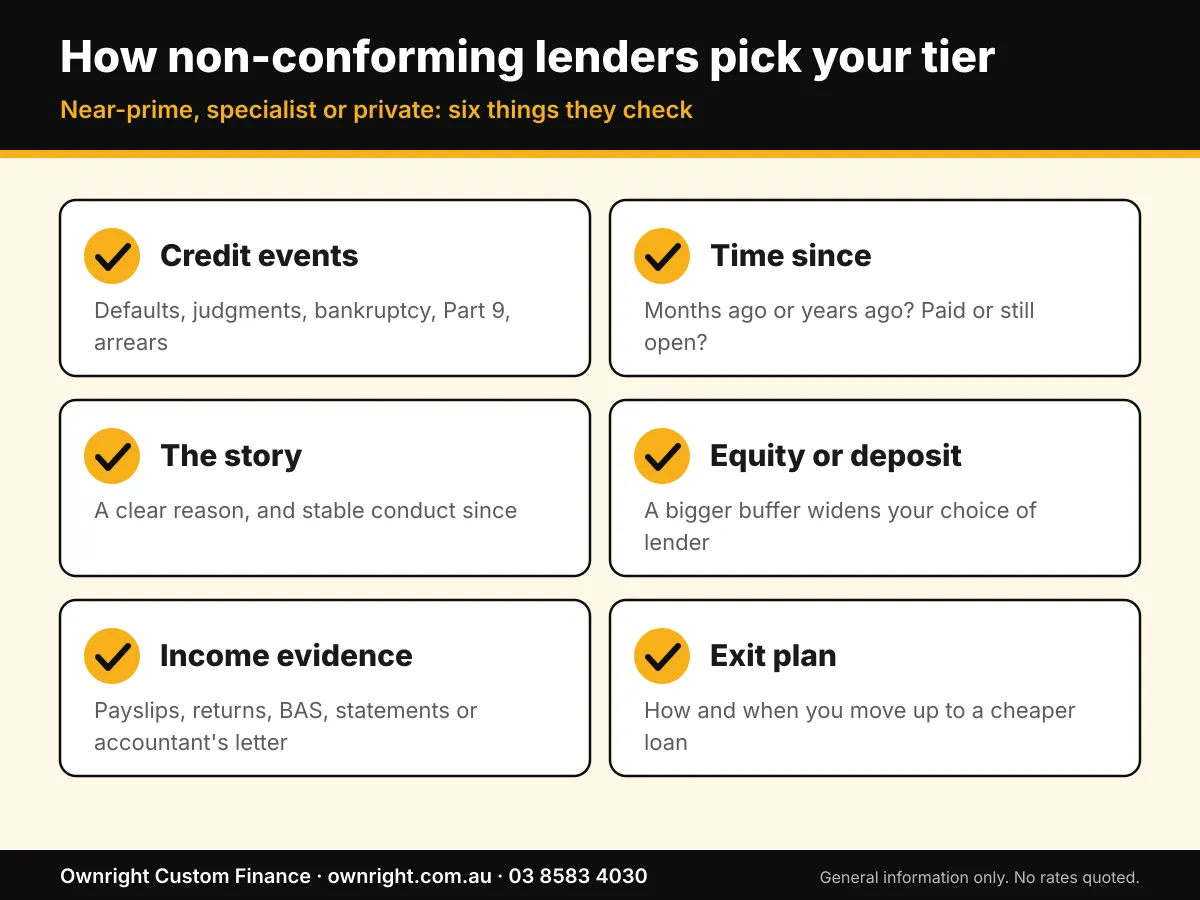
Which tier is your file likely to fit?
Use these questions as a rough guide. Your broker will refine it once they see your credit file.
| Question | Points towards near-prime | Points towards specialist or private |
|---|---|---|
| When was the last credit problem? | More than a year or two ago | In the last few months, or still current |
| Was it paid? | Paid or settled | Unpaid, or in arrears now |
| How big was it? | Small, such as a utility or phone bill | Large, such as a judgment or bankruptcy |
| Is there a clear reason? | Illness, separation or a one-off event, now resolved | No explanation, or repeated events |
| How much equity or deposit? | A comfortable buffer | Thin equity |
| Can income be shown? | Payslips, returns or good alt-doc evidence | Little evidence, or irregular income |
One strong answer can lift a file up a tier. A thin deposit with a recent unpaid default pushes it down. That is why we look at the whole file before choosing a lender.
Why your first application matters
Every formal application places a credit enquiry on your report, and enquiries stay there for five years. A string of declined applications in a short period tells the next lender something went wrong, and can push a near-prime file into the specialist tier. The safest approach is to have someone who knows the policies read your file first, then apply once, to the lender most likely to approve it.
What do non-conforming lenders cost?
We never publish rates, because pricing depends on the tier, the loan-to-value ratio, the property and the lender. The cost pattern is predictable, though:
- Each tier steps up in interest rate.
- Many specialist lenders charge a one-off risk fee instead of lenders mortgage insurance.
- Establishment, valuation, legal and settlement fees apply, as with any lender.
- Discharge and exit costs matter, because you plan to refinance later.
Ask for every fee in writing and compare loans over the period you expect to hold them.
Questions to ask before you choose a non-conforming lender
- Does the lender hold an Australian credit licence? You can check on ASIC’s professional register.
- Which tier is this product, and what would it take to qualify for the one above?
- What are the total upfront costs, including any risk fee?
- Are there exit, discharge or early repayment costs, and when do they end?
- Is the rate variable or fixed, and how has the lender’s pricing moved for existing borrowers?
- Does the lender offer a pathway product, such as a review or rate reduction after a period of clean repayments?
How to climb back up the tiers
A non-conforming home loan is easier to leave than most people think, provided you plan for it.
- Make every repayment on time, and set up direct debits so nothing slips.
- Avoid new credit applications, including buy now pay later and store cards.
- Keep tax returns and BAS lodged on time.
- Ask credit reporting bodies to correct any errors on your file.
- Review your loan when a major credit event passes a milestone, such as a default reaching five years.
An illustrative example
This scenario is illustrative only and does not describe a real client.
A Tasmanian nurse went through a separation that left a credit card in default. She paid it off within a year. Two years later she applied for a home loan with three lenders in a fortnight and was declined by all three, adding three enquiries to her file.
When she came to Ownright, her file still fitted near-prime: one paid default with a clear reason, a stable wage and a reasonable deposit. The extra enquiries needed an explanation, which we included. The lender makes the final decision, but her application now goes to one lender whose policy suits her, with the story told up front.
Where Ownright fits
Ownright’s director, Trevor Scott, has spent more than 40 years in finance, including as national sales manager at a specialist home lender and as chief executive of a large mortgage aggregation group. We know how non-conforming credit teams think because we have sat on their side of the table. We read your file, place it in the right tier and lodge it once.
Start an enquiry or call 03 8583 4030. For loans that need less paperwork, see no doc home loans, and for credit problems more broadly, bad credit home loans.
Ready when you are
Tell us about your loan
A short enquiry, no documents needed. Asking won't touch your credit file, and a real person who places hard loans every day reads it.
- Your plans
- A few details
- Contact
- Review
Enquiry only. No documents needed.
Frequently asked questions
What is a non-conforming lender?
A lender that approves loans outside the standard rules used by banks and their mortgage insurers. In Australia they are mostly non-bank lenders funded through warehouse facilities and securitisation, plus some specialist divisions. Each one writes its own policy on credit history, income evidence and property type.
What is a near-prime home loan?
A home loan for borrowers who are close to bank standard but miss on one point, such as a paid default, a short self-employment history or alternative income evidence. Pricing usually sits a step above prime, and the loan can often be refinanced to a bank once the issue ages.
Are non-conforming lenders safe to use?
Regulated non-conforming lenders must hold an Australian credit licence and follow responsible lending rules for consumer loans, the same as banks. Borrowers keep hardship rights and access to the Australian Financial Complaints Authority. Check the lender's credit licence and read the contract, including exit costs.
Can I go to a non-conforming lender directly?
Some take direct applications, but many specialist lenders work mainly through brokers. A broker who knows several policies can place your file in the right tier the first time, which avoids extra credit enquiries from multiple applications.
How do I move from a specialist loan back to a bank?
Keep every repayment on time, avoid new credit applications, keep tax lodgements up to date and let credit events age. Many borrowers review their position after a period of clean conduct. Check the discharge and exit costs on your current loan before refinancing.
Do non-conforming lenders charge mortgage insurance?
Some do, but many specialist lenders charge a one-off risk fee instead of lenders mortgage insurance. Either way, ask for the total upfront and ongoing costs in writing so you can compare loans properly.